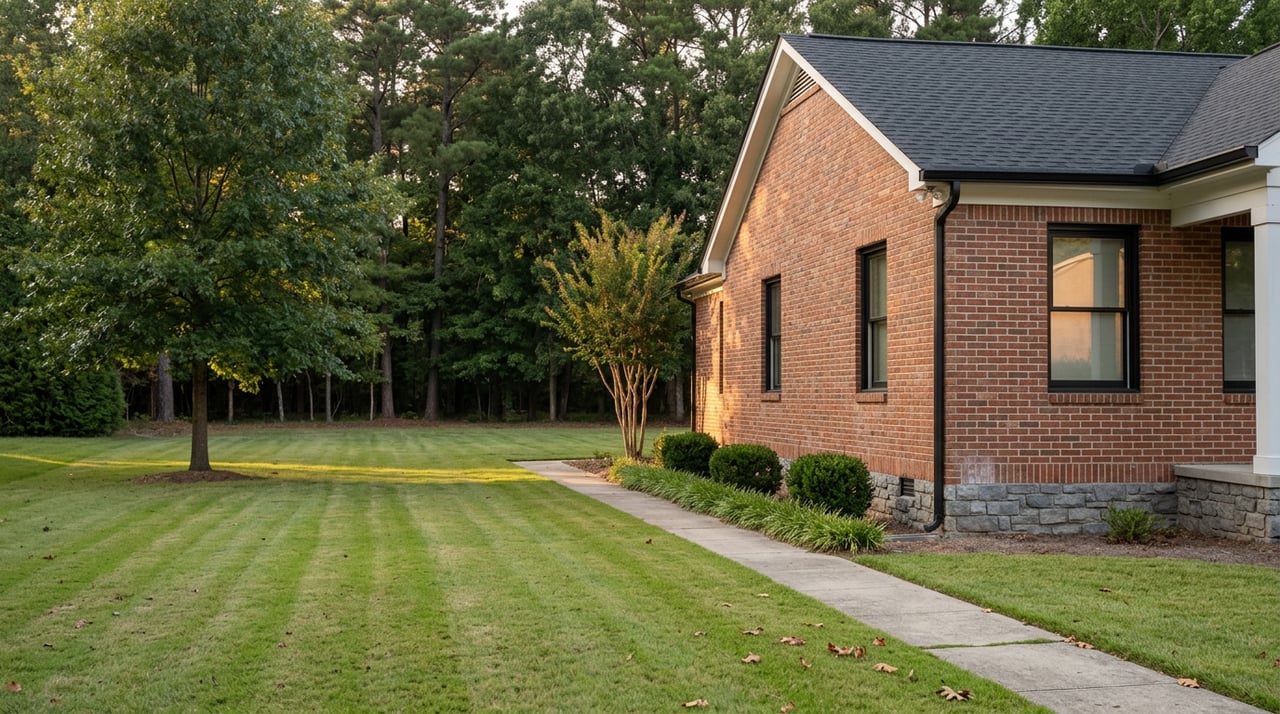
In Winder, the Real Property Line Runs Along the Sewer Main
August 20, 2026
August 20, 2026
What's the one thing two nearly identical Winder listings, same price, same square footage, same year built, will almost never tell you is different about them? It's not the lot shape or the school zone. It's whether the house flushes into a pipe the county or city maintains, or into a tank buried in the backyard.
That distinction rarely shows up as a headline feature on a listing sheet. It gets buried in the disclosures, if it shows up at all before closing. But in a county where growth is outrunning the pipe network, it's doing more to explain what a house actually costs you over five years than the subdivision name ever will.
Buyers comparing homes in Winder tend to sort by the numbers a portal puts in bold: price, square footage, days on market. Those numbers get you into the right range. They don't tell you whether the monthly bill includes a wastewater line item from the city, or whether your only wastewater cost shows up every few years when a truck comes to pump a tank.
That gap matters because Barrow County's public sewer system doesn't reach most of the county. The Barrow County Wastewater Department serves roughly 2,755 customers, spread across unincorporated Barrow County, the City of Auburn, the City of Statham, and only parts of the City of Winder itself. A huge share of homes sitting inside a "Winder" mailing address, the kind that shows up in a portal search for the city, are not actually connected to that system or to the city's own utility. They're on septic. And nothing in a standard listing photo set flags which category a given house falls into.
This isn't an oversight. It's geography and cost. Sewer lines are expensive to run to low-density areas, and a lot of Barrow County is still low density by design, larger lots, longer setbacks, more distance between rooftops. Extending a gravity sewer line or a pump station out to serve a handful of houses on five-acre parcels rarely pencils out the way it does in a denser subdivision closer to downtown.
That's part of why Barrow is named specifically, alongside Forsyth, Cherokee, Jackson, and Henry, as one of Georgia's fastest-growing counties actively extending sewer infrastructure into what used to be rural land. The extension is happening. It just isn't happening everywhere at once, and it isn't happening on a timeline a buyer touring homes this month can bank on.
Here's where the two paths actually diverge in dollars. A septic system doesn't show up as a monthly utility bill. It shows up as an upfront installation cost when the system goes in, and then as occasional maintenance, pumping, and inspection expenses after that. Statewide, that ongoing cost typically runs somewhere between $160 and $325 a year. Installation is the bigger number: a standard system across Georgia's Piedmont clay counties, the geology under most of Barrow, runs about $6,400, but clay soil often forces an engineered mound or aerobic system instead of a conventional one, which pushes the number to $15,000 or more.
Public sewer flips that structure. There's no five-figure install cost sitting on a septic-owner's future balance sheet, but there is a bill every month, and the City of Winder's own rate schedule shows that bill climbing. The base fee for a standard 5/8 to 3/4 inch line rose from $19.10 in 2024 to $20.44 in 2025, with additional phased increases the city has scheduled through 2026. Volume rates moved the same direction: the residential water rate for the first tier went from $3.37 to $3.61 per thousand gallons, and the sewer volume rate rose from $5.62 to $6.01 per thousand gallons in that same 2025 adjustment.
| Septic | Public sewer (Winder rates) | |
|---|---|---|
| Upfront cost | ~$6,400 conventional, $15,000+ for engineered systems on clay soil | Typically none, cost is embedded in the build or purchase price |
| Ongoing cost | ~$160–$325/year statewide, pumping and inspection | Monthly bill, base fee plus volume, rising through 2026 per city schedule |
| Who inspects it | Barrow County Environmental Health, required before certain permits | No environmental health approval required for permit applications |
| Predictability | Fixed once installed, occasional maintenance spikes | Tied to city rate schedule, subject to further increases |
Neither column is automatically the better deal. A septic system with documented pumping history holds its value just fine in most Georgia counties outside the immediate Atlanta core. The point is that two houses priced identically today are carrying two very different cost shapes going forward, and the listing price doesn't disclose which shape you're signing up for.
There's a second layer to this that has nothing to do with monthly bills and everything to do with paperwork you might not expect to sign. In 2021, Winder's city council adopted an ordinance requiring property owners along the municipal boundary, if they wanted to connect to city water and were eligible to annex, to actually do so. If a property requesting a hookup wasn't contiguous with the existing city limits, the owner had to sign a restrictive covenant agreeing to annexation once the property did become contiguous through future growth. Refuse, and the city retained authority to cut off water service.
By fall 2024, that policy had generated enough pushback that the council placed a 90-day moratorium on it while the city worked through a broader zoning and subdivision code amendment. That's a useful data point less for its current status, which is worth confirming directly with the city before you rely on it, and more for what it tells you: connecting to city utilities in Winder has, at times, come bundled with a legal commitment to future annexation, not just a hookup fee. If a listing advertises "city water available" on a parcel outside current city limits, that's a question worth asking before you assume it's a simple utility upgrade.
Barrow County secured a $2 million grant from the Appalachian Regional Commission this summer to expand the Tanners Bridge Wastewater Treatment Facility, with the county putting up roughly $7.6 million more from its own water and sewer funds. The expansion will lift the facility's treatment capacity to 2 million gallons per day, aimed squarely at supporting growth along the Highway 316 corridor.
That's real infrastructure money moving toward real capacity. It's also, as of the announcement, a project without a published construction start date or completion date. If you're eyeing a septic-served property because you're betting sewer access is coming soon, treat that bet as a directional signal about where the county is investing, not a countdown clock. The capacity is being built for the corridor's growth generally. It is not a guarantee that a specific unincorporated parcel gets a connection point in any particular year.
A few questions do more work here than any amount of scrolling through comps:
None of these questions will show up in a portal filter. All of them change what you're actually agreeing to pay.
Does being on septic hurt resale value in Winder? Not inherently. A well-maintained system with documented pumping history is generally as marketable as sewer across most Georgia counties outside the immediate Atlanta metro core, Barrow included.
If the Tanners Bridge expansion finishes, will my septic system get replaced automatically? No. The expansion adds treatment capacity for the Highway 316 corridor generally. Connecting an individual property still requires its own extension, application, and cost, and no timeline for that has been published.
Can I just ask the listing agent whether a house is on septic or sewer? You can and should, but confirm it against the county's own permit and utility records rather than taking a verbal answer at face value, since the answer changes what inspections and approvals apply to the property going forward.
If you're weighing two Winder listings that look identical on paper and want someone to pull the utility, permit, and annexation history apart before you write an offer, that's exactly the kind of groundwork Dinu Dariy does for buyers in this market. Reach out for a free home valuation and a straight answer on what a specific address is actually connected to.
Stay up to date on the latest real estate trends.
Want an agent who'll really listen to what you want in a home? Need an agent who knows how to effectively market your home so it sells? Give me a call! I'm eager to help and would love to talk to you.